client tools and surfaces built to run — not demos parked on the side
Workflow products
Custom Tools & Workflow Products
When the gap is a real surface — not another page in the CMS — custom tools turn messy workflows into something your team and customers can actually run.
Sometimes the business does not need more content. It needs a thing that works: a customer-facing configurator, a staff dashboard, a quoting or eligibility flow, a partner portal, or an internal app that closes the loop between marketing, sales, and operations. Off-the-shelf products force you into their model. Spreadsheets and one-off forms break under volume. A custom workflow product is scoped to your rules, your data, and how you already sell — then wired into the CRM, the site, and measurement so it is not a science project on the side. This sits next to CRM architecture and agentic systems work: CRM is the spine, automation removes drag, and this offer is the durable interface layer — the product-shaped build buyers and staff touch every week. It is not generic app development. It is demand capture and operational clarity in a focused build.
Typical investment$4K–$30K+ · Scoped by surface complexity, integrations, and rollout depth
Diagnose before engagement
Try CMO Roadmap Generator first.
Build a practical plan you can execute or bring into engagement.
Audit snapshot
customer- and operator-facing flows kept in sync where the business requires it
integrations and CRM/site context treated as part of the product, not an afterthought
Signs you need this
- You keep duct-taping the same workflow with forms, spreadsheets, and email because nothing off-the-shelf fits how you actually sell or deliver.
- Customers or partners need a guided flow — quote, configure, qualify, book — that a static site page cannot carry.
- Staff live in scattered tabs; the “source of truth” is still partly in someone’s head.
- You are about to buy another SaaS seat hoping it fixes a problem that is really your rules and data model.
- Marketing and ops agree the website is not enough, but they cannot describe the product-shaped build they need in one sentence — yet.
- You already improved CRM or automation, but the **visible layer** people use daily never got built.
- You want one accountable owner for strategy and implementation — not a dev shop that disappears after handoff.
What this usually includes
- Jobs-to-be-done and scope framing — what the tool must do for customers or staff, what it must never pretend to be, and how it connects to revenue or throughput
- UX and data-flow design — roles, states, handoffs, and what has to sync to CRM, commerce, or ops tools
- Build or integration blueprint — what ships as custom surface vs what stays in the existing stack (and how they talk)
- Implementation direction or hands-on build — production-minded delivery, not a throwaway prototype
- Rollout, ownership, and training hooks — who runs it day to day and how it survives the first busy quarter
- Measurement and iteration tie-in — how you will know it is working and what to tighten next
Common questions
Related proof
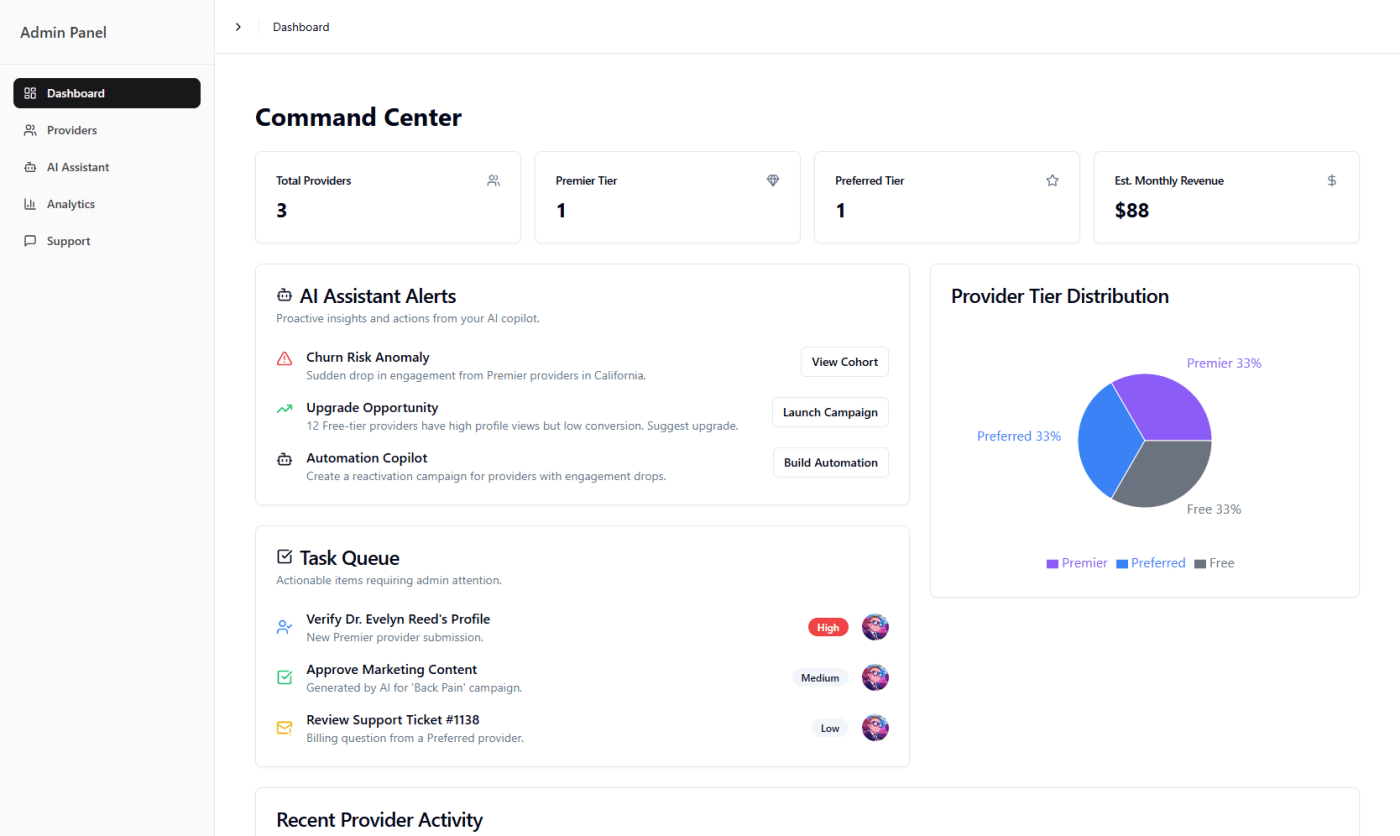
Live build
See the Graston Growth Engine in action.
A two-sided provider directory with real-time spatial search, AI-powered support automation, and a per-provider analytics dashboard — built as a production system, not a demo.
Related case studies
Related services
CRM & AutomationWeb DevelopmentLead Gen WorkflowsHealthcareSaaSE-CommerceB2BLocal Service
Ready to get started?
I work with a small number of clients at a time. Every engagement gets my full attention.